Product number: 15953


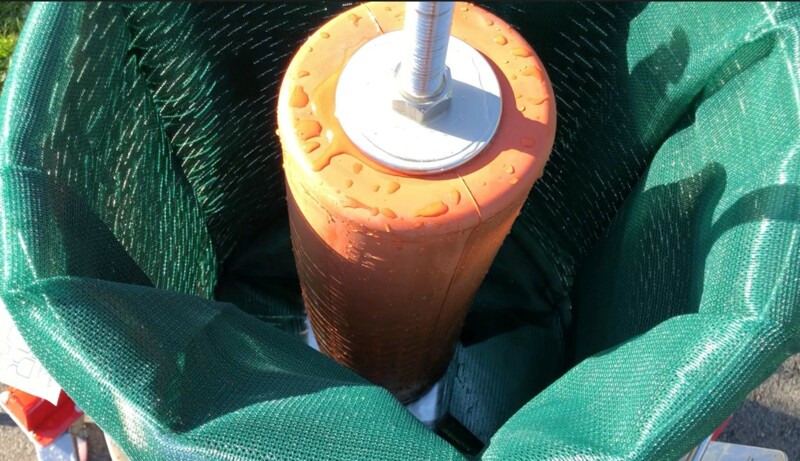
VSX 35 has a 35-litre basket for processing prepared fruit mash and grapes into juice or must. Water pressure expands the internal membrane, pressing the mash against the perforated basket. No electrical connection is required.
Standard equipment includes a pressure regulator, a green pressing net and a protective cover to contain splashing juice. A lees filter bag for the 35-litre press is available as an accessory.
Prepare or mill the fruit before pressing. Follow the VSX 35 instructions when filling the basket, setting the pressure and using accessories. Pressing time depends on the fruit and mash preparation. The press operates with water; compressed air must not be used.
Model: VSX 35 · SKU: 15953 · Basket capacity: 35 l.
With these presses, it is important to understand that they are not automatic, so specifying an hourly pressing capacity is irrelevant. The pressing time varies depending on the type of fruit.
Apples must be ground before pressing. Pressing the ground apples is very fast – one pressing cycle can be completed in about 30 minutes. Pressing is carried out at high pressure.
For red grapes, it must be taken into account that the crushed grapes need to rest for 2–3 days before pressing. Afterwards, pressing is very easy and fast – up to 30 minutes, also at high pressure.
For white grapes, it is important that they are pressed immediately after crushing to prevent discoloration (oxidation). For better pressing results and to prevent oxidation, it is recommended to add enzymes to the crushed mass, which help break down the grape skins and thus allow faster pressing. If this is not done, white varieties must be pressed slowly at low pressure, which can take 2 hours or more.
The LANCMAN press models VS_170 and VS_250 operate at a water pressure of up to 2.5 bar.
The models VS_55, VS_80, and VS_120 require a mains pressure of up to 3 bar.
Smaller models require a mains pressure of approximately 4 bar.
Most household water connections provide a pressure between 3 and 5 bar, which is sufficient for normal operation.
If the mains pressure is not adequate, you can use a simple water pump to draw water from a tank, or a water pressure booster system.
The manometer in the press is always active and does not need to be switched on separately. Its function is to display the pressure in the system. For the manometer to show a reading, back pressure must build up in the system – this means that the water or liquid in the system resists flow due to outlet closure or pressing. When this happens, the manometer detects the pressure and displays it on the scale.
It is important to understand that the manometer does not measure the amount or flow of water, but only the current pressure in the system. Therefore, it is normal that during free flow without resistance the pointer remains at zero, while under load (pressing) the pointer moves and shows the actual pressure.
The use of compressed air is strictly prohibited.
This prohibition is not related to warranty conditions, but to serious safety risks.
The problem is not the air itself, but the large amount of energy stored in compressed air.
For example, at a pressure of 3 bar in an 80-liter tank, the pressure-energy product amounts to 240 bar-liters.
This represents a significant accumulation of potential energy, which, in the event of a sudden release, can result in explosive decompression, component damage, or even severe personal injury.
Unlike hydraulic media (e.g. water), which are incompressible and do not store energy in the same way, compressed gases accumulate energy that is released violently in the event of system failure.
Our equipment is neither designed nor certified for use with compressed air, and such use therefore represents an unacceptable safety risk.
We explicitly warn against such use.
With a water press, it is important that the basket is filled before pressing. This way, the rubber membrane can expand evenly and ensure uniform pressure. If the press is not completely filled, there is a risk that the membrane will rub against the basket, which is not ideal and may eventually damage the rubber.
In any case, we recommend always using the plastic mesh during pressing. Insert it so that the mesh touches the inside of the basket, thereby protecting the membrane from damage caused by rubbing against the basket. For smaller quantities, you can also reduce the basket volume by partially inflating the membrane before filling, but make sure it does not yet touch the basket. Then add the fruit and continue with pressing.
In this way, you can efficiently press even smaller quantities while at the same time protecting the long service life of the machine.


Mon - Fri: 7.30- 16.30
Saturday: 7:30 - 11.30
Sun. and holidays: Closed

© 2023, Gomark d.o.o., vse pravice pridržane.